

I didn't like Heated Rivalry
But I like what it makes hockey people do

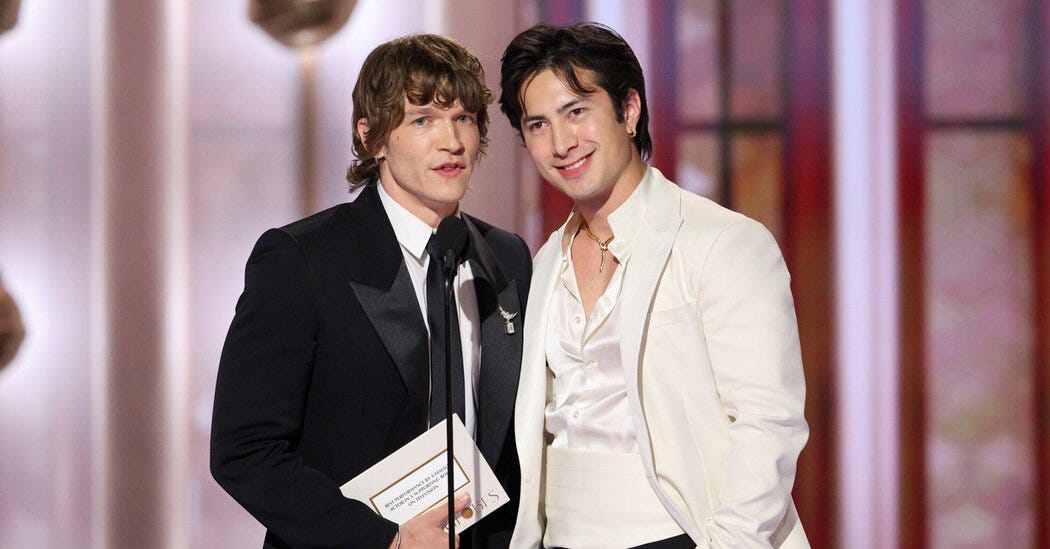
As a full-blooded Canadian hockey fan whose musical taste was forged in the indie rock of the late 90s and early 2000s, I couldn’t escape Heated Rivalry. It was everywhere. It dominated my social feeds and sat firmly at number one on the charts the second I opened my streaming app. Even my friends, the ones who usually only post about advanced stats, were posting memes about it. So, like Michael Scott desperate to be part of an inside joke, I finally got to be a part of one.
I already had a vague idea that “hockey romance” was a juggernaut in the BookTok community. Much like the Romantasy phenomenon, athlete-based erotica has become a massive staple on Wattpad and in fanfic circles. I also remember the fallout from a couple of years ago involving Alexander Wennberg of the Seattle Kraken; his wife eventually had to ask people to stop sexually harassing him because of the “hockey booktok” obsession. It was an unfortunate mess, partly fueled by the Kraken’s own social media team, and I worried it would alienate women and gender-diverse fans, the very people hockey desperately needs to diversify its fanbase.
Now, regarding the show and the book: I’m just not a fan.
It’s not because of the amount of gay sex (of which there is plenty) or because it centers on a queer story. At the risk of sounding like “the lady doth protest too much,” some of my favorite romance movies are queer romances, Brokeback Mountain, Y Tu Mamá También, Call Me By Your Name, or Portrait of a Lady on Fire (a true five-star masterpiece). I’m not a prude about romance, and I’m certainly not a prude about sex. If a romance is well-executed, I don’t care who is in the relationship.
The problem is that Heated Rivalry felt schmaltzy and over-tropey. The acting was stilted, the pacing was off, and I never truly bought why these two guys loved each other. But here’s the thing: despite the quality, I loved that it brought mainstream awareness to 2000s-era Canadian indie rock and, more importantly, to the existence of gay hockey players.
You see, I have a love-hate relationship with hockey. Growing up in a hockey town with a deep history, you can’t escape the sport. But it’s not that I’m trying to get away; when hockey is good, it’s damn good. It’s one of the fastest sports in the world, and the playoffs offer the most heart-wrenching drama in professional sports. There have been countless times I’ve watched a game with my stomach in my throat, telling my wife to stay positive so she doesn’t “jinx” the boys. At its best, the NHL provides a truly elevated feeling. That’s when I love the sport.
But to be a hockey fan in 2026, especially a progressive one, means you have to swallow the “ugly” side, too. For a sport that struggles to keep pace with the popularity of the MLS, it has a lot of baggage. We still deal with rampant sexism, racism directed at non-white players and fans (I know I have faced my fair share of it), and a constant stream of sexual harassment stories. Just last year, the public was rocked when several Hockey Canada players were found not guilty in a highly publicized sexual assault case. Then, there’s the homophobia.
Now Heated Rivalry is forcing the NHL to confront its own homophobia in the funniest way possible, and for that, I’m a huge fan.
This confrontation was long overdue. This is a sport that claims “hockey is for everyone” while doing everything in its power to tell queer people, “Actually, nah.” We’ve seen it from bold-faced MAGA supporters like Matthew Tkachuk and Wayne Gretzky (a traitor in my Canadian eyes), to players like Eric Staal who refused to wear Pride jerseys because of their “beliefs”—whatever those are. And let’s not forget the cowardice of Commissioner Gary Bettman, who scrapped players wearing Pride jerseys altogether to appease those people.
It also matters that Heated Rivalry is a Canadian show, produced by the same team that brought us Letterkenny. In Canada, hockey players of all ages are held in high esteem, especially in small towns. Think of the “asshole high school quarterback” trope in America, but give him an Ontario accent, a backward hat, and a very specific vocabulary. That is the “Hockey Boy” archetype. Whether it’s fair or not, that stereotype exists, and plenty of former players turned adults still act like being a “Hockey Boy” is the pinnacle of masculinity.
Now, in an Olympic year, especially one where American politicians are making noise about threatening Canadian sovereignty, a big Olympic gold would be therapeutic for the country. We are, as a nation, depending on these “Hockey Boys.” I can only imagine the ego boost they’re feeling.
But in 2026, with the “fate of the country” in their hands, these players are being forced to answer questions about a show famous for gay hockey sex. It’s beautiful. It’s a direct challenge to their dominant masculinity and their hegemony. It’s forcing them to be allies.
The show has brought in fans the NHL never thought it would see, mostly non-male, non-straight fans who watch the real-life highlights and wonder why the rivals don’t just kiss. It’s making the pros contend with the fact that there are likely gay players in their locker rooms right now. It’s forcing them to ask: If my teammate were gay, what would I do? I can’t imagine the conversations happening in locker rooms because of this show, but they are clearly conversations that needed to happen.
I hope the lasting legacy of Heated Rivalry (regardless of my thoughts on the acting) is that an NHL player finally feels safe enough to come out and be celebrated for it. If that happens, the show’s legacy will be legendary, perhaps the most important piece of Canadian media we’ve ever produced.
Then, hopefully, the second season will get better writers.